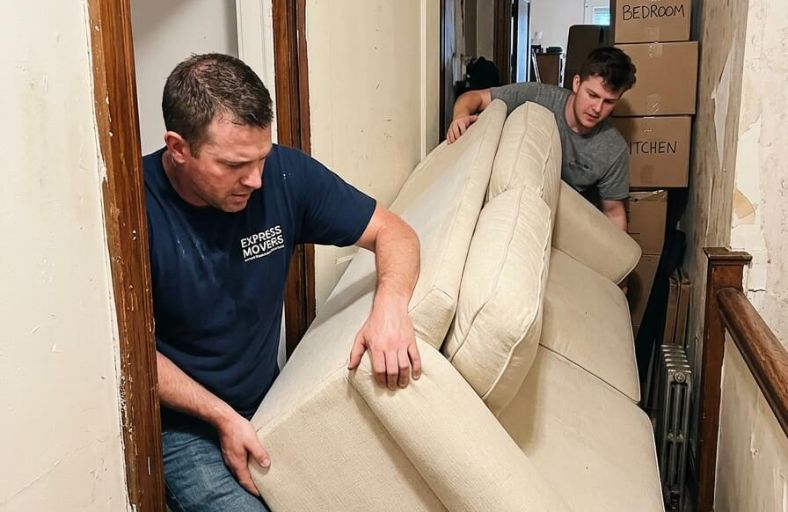
There’s a reason moving a couch through a doorway has become a universally relatable source of stress and dark humor.
The moment that oversized piece of furniture meets a standard doorframe, things can go sideways fast, sometimes literally.
But what feels like an impossible task is usually just a problem that hasn’t been approached with the right strategy yet.
Measuring correctly, removing door hardware, and understanding how to angle and pivot a large sofa can make an enormous difference in how smoothly the process goes.
Mastering the Math
Precision in measurement serves as your primary defense against structural damage and moving-day gridlock.
You must record the dimensions of both the environment and the asset itself before the physical movement begins.
The most critical metric for any couch move is the diagonal depth. This measurement identifies the smallest possible profile the sofa can present when tilted.
To find it, place a straightedge from the highest point of the back to the top of the armrest, then measure from the rear bottom corner of the frame to the midpoint of that straightedge.
| Dimension Type | Purpose | Measurement Strategy |
| Clear Door Width | Defines horizontal entry | Measure inside edge to opposite stop |
| Diagonal Depth | Determines tilt viability | Measure from bottom back to top front midpoint |
| Door Height | Impacts vertical pivots | Measure from floor to top of the frame |
The doorway width must exceed at least one of these sofa measurements for a successful transit.
Strip-Down Strategy
Most modern sofas are manufactured as assemblies of individual components rather than monolithic blocks.
When the doorway envelope is smaller than the primary dimensions, you should immediately start a structural reduction.
Begin by removing all non-structural elements like cushions and pillows. This reduces weight and reveals the underlying frame.
The removal of sofa legs is the single most effective intervention, often gaining you 2 to 8 inches of vital clearance.
For particularly stubborn fits, check for internal bolts hidden under the upholstery flaps to detach the armrests.
Always place every screw, bolt, and washer into a labeled, sealed plastic bag and tape it directly to the piece to ensure a frustration-free reassembly.
Widening the Frame
If the sofa is still a fraction of an inch too large, you must modify the architecture of the home. A standard interior door sitting at a ninety-degree angle occupies about 1.25 to 2 inches of width within the frame.
By removing the door from its hinges, you reclaim the maximum theoretical width of the frame.
To do this, close the door and use a hammer and a nail to tap the hinge pins upward from the bottom until they pop out.
Once the pins are removed, slide the door sideways to detach it from the hinges. This simple task takes only minutes but can make the difference between a stuck couch and a successful move.
The Art of the Hook
The hook method is a professional technique used to navigate large furniture through doorways where a straight horizontal approach is impossible due to a narrow hallway.
This maneuver exploits the fact that the diagonal space of a doorway is often larger than its horizontal width.
To execute this, turn the sofa on its side or tilt it at a high angle. You then move the back of the sofa through the door first, with the seat facing away from the frame.
By hooking the back around the door frame into the room, you allow the rest of the frame to follow in a fluid, curling motion.
The Vertical Pivot
Since most standard interior doors are 80 inches high, the vertical pivot is often your most powerful move.
If your sofa is shorter than the height of the door, standing it on one end allows you to use the vertical clearance to your advantage.
Start by raising the couch upright onto its side. One person should control the top to prevent toppling while the other manages the base.
You can then walk the lower end through the door and rotate the top half through in a fluid, curling motion.
Always place a thick moving blanket or a moving shoe under the contact end to protect both your flooring and the sofa’s frame from damage during the pivot.
Tactical 45-Degree Tilting
When a straight horizontal entry fails by just an inch or two, a tactical 45-degree tilt is usually the solution.
This technique is particularly effective for sofas with high backs or prominent rolled arms.
By tilting the couch forward so the back angles toward the ceiling, you reduce its effective horizontal footprint to the diagonal depth.
This allows you to hook the leading armrest through the door frame first, followed by a twisting motion to bring the rest of the frame through.
It is vital to have a helper inside the room to guide the leading edge and ensure it doesn’t snag on the door stops or latch plates.
Mechanical Advantage
Professional movers rarely rely on muscle alone. Using the right tools can turn a high-stress maneuver into a controlled process.
Furniture sliders are essential for making micro-adjustments on carpet or hardwood without straining your back.
If you have a long hallway leading to the door, a four-wheel flat dolly can support the entire weight of the sofa, allowing you to focus on steering rather than lifting.
| Tool | Best Surface | Main Benefit |
| Furniture Sliders | Carpet / Hardwood | Effortless gliding for precise positioning |
| 4-Wheel Flat Dolly | Flat, even floors | Supports up to 1,000 lbs; saves your back |
| Moving Straps | Stairs / Thresholds | Redistributes weight to legs and core |
Using these tools ensures that the move remains steady and that you can stop instantly if you feel the sofa start to wedge.