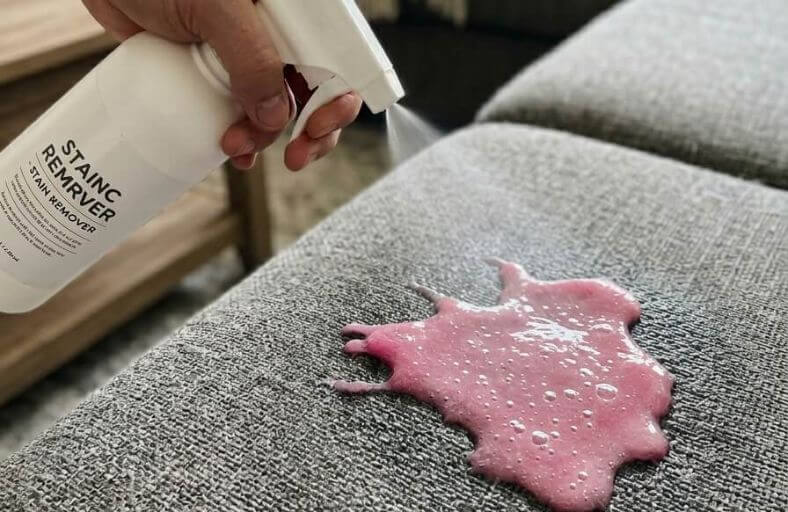
A vibrant, neon-purple glob of homemade slime sits squarely on your oatmeal-colored bouclé cushions, catching the afternoon sun in the most terrifying way.
This sticky hybrid of school glue and contact lens solution begins a slow migration into the deep crevices of the weave, threatening to transform a high-end investment into a permanent aesthetic disaster.
Seeing a child’s latest experiment fusing with delicate designer fibers is a quintessential modern nightmare for any homeowner.
It represents a clash between the joyful chaos of sensory play and the rigid demands of textile maintenance, requiring a strategic chemical intervention that respects the structural integrity of your furniture.
Before applying any treatment, you must identify your sofa’s cleaning code to avoid permanent damage like water rings or fiber shrinkage.
Quick Reference: Upholstery Cleaning Codes
| Code | Meaning | Safe Cleaning Agents |
| W | Water-Based | Mild detergents, water-based foams, and shampoos. |
| S | Solvent-Based | Water-free dry-cleaning solvents only. |
| WS | Water or Solvent | Both water-based and solvent cleaners are acceptable. |
| X | Vacuum Only | Professional service only; no liquids. |
Spoon Scraping
The most critical step in sofa restoration is removing the bulk polymeric mass before it integrates into the fabric weave.
When the slime is still fresh and wet, your goal is to lift it upward and away from the surface rather than pushing it downward.
A blunt tool, such as a stainless steel spoon or a rigid plastic card, is significantly safer than a knife, which can snag and break delicate threads in the upholstery.
Hold the tool at a 45-degree angle and use a gentle scooping motion to peel the majority of the slime away.
Always work from the outer edges of the spill toward the center to prevent the glob from spreading further across the cushion.
For long-fiber fabrics like chenille or velvet, this stage requires extra patience to ensure the slime is detached from individual strands without causing pilling or matting of the nap.
Ice Cube Freezing
If the slime has become excessively sticky or has started to dry, freezing is a highly effective method for changing the material’s physical state.
By lowering the temperature of the polymer, it reaches a glass transition point where it becomes brittle and loses its adhesive properties.
To execute this safely, place several ice cubes in a sealed plastic bag to prevent melting water from saturating the sofa fabric, which is especially important for S-coded materials.
Hold the ice pack against the slime for 10 to 15 minutes until the mass feels hard to the touch.
Once frozen, the slime can often be fractured into small pieces and lifted away using a spoon or even your fingernails.
This technique is particularly recommended for microfiber and suede-like materials, where the dense fiber structure can trap wet slime like a sponge.
Freezing keeps the mess localized and prevents it from being driven deeper into the backing.
White Vinegar Soak
The most powerful tool against slime is distilled white vinegar. The acetic acid found in household vinegar acts as a chemical neutralizer for the borate ions that hold the slime together.
When vinegar is applied, it disrupts the hydrogen bonds, causing the polymer to lose its structure and revert into a liquid, non-sticky state.
Mix a solution of two parts white vinegar and one part warm water in a spray bottle and apply it liberally to the remaining residue. After allowing the solution to sit for 5 to 10 minutes, the slime will begin to dissolve.
You can then use a soft-bristled brush or an old toothbrush to gently agitate the area in a circular motion, lifting the liquified polymer out of the fibers.
This method is the primary choice for most W-coded fabrics and is incredibly effective at reversing the cross-linking reaction.
Dish Soap and Water
For slimes that contain significant amounts of oil, such as those made with shaving cream or baby oil, a surfactant is necessary to break the surface tension and lift the grease.
Liquid dish soap is designed specifically to surround oil molecules and make them water-soluble, allowing them to be rinsed away.
This is also an excellent secondary treatment after a vinegar soak if a sticky film remains on the sofa.
The recommended ratio is two teaspoons of mild dish soap to two cups of warm water. Apply this solution with a clean cloth or sponge using a blotting motion rather than vigorous scrubbing.
By working the soap into the fibers, you emulsify any lingering polymer fragments and oils. Finally, blot the area with a fresh, damp cloth to remove the soap residue, as leftover detergent can attract more dirt over time.
Rubbing Alcohol Blotting
Rubbing alcohol, or isopropyl alcohol, is a highly effective polar solvent that can dissolve synthetic pigments and the food dyes often found in commercial slime.
Because it evaporates quickly, it is often safer for fabrics that are sensitive to prolonged moisture, though it must always be tested on a hidden spot first to ensure it does not damage the fabric’s own dyes.
To use this method, saturate a clean white cloth or cotton ball with rubbing alcohol and press it firmly against the slime stain.
The alcohol works to liquefy the remaining polymer and pull the coloring agents out of the sofa’s yarns.
This transfer method is crucial; you want to lift the stain into the cloth rather than spreading it further across the cushion.
For colorful slimes that have left a neon shadow on your upholstery, rubbing alcohol is frequently the most successful DIY option for pigment neutralization.
Baking Soda Neutralization Paste
Baking soda serves a dual purpose as both a mild abrasive and a powerful odor neutralizer. For lingering sticky residues, you can create a thick paste by mixing baking soda with a small amount of water.
This paste should be smeared over the affected area and allowed to dry completely, which may take several hours.
As the paste dries, it draws moisture and dissolved polymer particles out of the fabric weave through capillary action.
Once it has hardened into a crust, you can simply brush it away or vacuum it up, taking the slime residue with it.
This method is particularly useful for neutralizing the sharp scent of vinegar if used in a previous step.
For W-coded fabrics, a mixture of baking soda and vinegar can create a bubbling reaction that helps physically blast slime particles out of deep textile structures.
Club Soda Lift
For delicate fabrics where heavy detergents are not advised, plain club soda offers a gentle yet effective cleaning alternative.
The carbonic acid in club soda provides a mild effervescent action that can help loosen the grip of the slime on individual fibers without the risk of leaving behind a soapy residue. It is often used as a safe first-response treatment when a spill is still fresh.
The carbonation creates tiny bubbles that penetrate deep into the weave, lifting the sticky slime toward the surface where it can be easily blotted away.
While it may not have the chemical power of concentrated vinegar to dissolve massive globs, it is an excellent flushing agent to use between other cleaning steps.
Homeowners prefer club soda for its neutral pH and lack of scent, making it safe for a wider range of upholstery types compared to harsher acids.
The Limonene-Based Commercial Solvent Application
In cases where slime was formulated with heavy oils, waxes, or industrial glues, common household items may prove insufficient.
Commercial citrus-based cleaners utilize d-limonene, a solvent derived from citrus peels, which is specifically engineered to dissolve strong adhesives and greasy residues.
These products are highly effective at breaking down synthetic polymers that resist standard water-based treatments.
However, citrus solvents are extremely powerful and can damage the backing materials of certain sofas or dissolve the dyes in leather.
They should always be applied sparingly to a cloth first and blotted carefully onto the stain.
After the slime has been loosened and removed, you must thoroughly rinse the area with a damp cloth to remove the solvent residue, as lingering limonene can cause long-term degradation of synthetic fibers.
Warm Cloth Application
When slime is discovered days or weeks after the initial spill, it often becomes hard, brittle, and seemingly fused to the sofa fibers.
Attempting to scrape petrified slime while it is dry can easily tear the delicate upholstery threads.
The first step for aged slime is hydrothermal rehydration. This involves saturating a clean white rag with warm water and laying it directly over the dried glob for at least 30 to 60 minutes.
The heat and moisture slowly penetrate the polymer network, swelling the chains and making them pliable once again.
For particularly stubborn patches, some homeowners have success using a warm iron placed over a damp towel to create a localized steam effect, though this must be done with extreme caution on S-coded fabrics to avoid shrinkage.
Once the slime has reached a gummy state, it can be treated with vinegar or dish soap as if it were a fresh spill.
Liquid Detergent
Many homemade slimes use PVA glues formulated with organic stabilizers, while some fluffy recipes incorporate shaving cream or even cornstarch.
In these cases, a high-quality liquid laundry detergent containing proteolytic enzymes is the most effective tool.
These enzymes are biological catalysts designed specifically to break down protein and starch-based bonds at the molecular level.
Apply a small amount of detergent directly to the residue and rub it gently into the fibers using a soft brush or your fingertips.
Let the detergent sit for 5 to 10 minutes to allow the enzymes to eat the organic components of the glue, but do not let it dry on the fabric.
Afterward, blot the area with a warm, damp cloth to rinse. This method is particularly effective for removing the crusty residue that often lingers after the bulk of the slime has been removed.
Hydrogen Peroxide
If the slime contained heavy concentrations of food coloring or neon ink, a shadow of pigment may remain even after the sticky polymer is gone.
For white or very light-colored sofas, hydrogen peroxide can act as a mild bleaching agent to oxidize the pigment molecules.
This is a safer alternative to chlorine bleach as it breaks down into water and oxygen, but it still requires a colorfastness test first.
Apply a 3% hydrogen peroxide solution sparingly using a cotton ball or a clean white cloth. By dabbing the stain, you can watch the pigment fade as the chemical reaction occurs.
It is essential to rinse the area with a damp microfiber cloth afterward to remove any excess peroxide, preventing it from continuing to react with the fabric fibers over time.
This technique is a favorite for white linen or polyester sofas that have suffered a neon slime incident.
The Oxygen-Based Whitening Soak
For widespread slime contamination or for cushions that have removable covers, an oxygen-based whitening soak containing sodium percarbonate can provide deep remediation.
Unlike liquid bleach, oxygen whiteners are generally color-safe and work by releasing active oxygen to lift stains from within the fiber weave.
If the sofa cushion cover is removable, soak it in a basin of warm water mixed with oxygen whitener for 30 to 60 minutes.
This long-duration soak allows the whitening agents to penetrate the core of the yarns, lifting both the slime residue and any accompanying dyes.
After soaking, launder the cover according to the manufacturer’s instructions. If the cover is not removable, a concentrated solution can be blotted onto the stain and covered with a damp cloth to keep it active for an extended period.
The Bond-Buster Specialized Cleaning Wipes
When dealing with a high-stakes mess on a luxury sofa, specialized heavy-duty cleaning wipes, such as Tub O’ Towels, can be a game-changer.
These wipes are engineered with Bond Buster technology, specifically designed to dissolve the molecular bonds between a sticky contaminant and the fabric surface.
Unlike standard baby wipes, which may contain oils or lotions that worsen a stain, these industrial-strength wipes use a biodegradable blend of detergents and emulsifiers.
The primary benefit is the controlled application of cleaning agents. Because the wipe is evenly saturated but not dripping, there is a lower risk of over-wetting the sofa backing, which is critical for maintaining structural integrity.
The textured surface of the wipe also provides a mild mechanical scrubbing action that helps trap and pull slime particles away from the yarns. This is a convenient, high-performance solution for quick responses to new spills.
Cornstarch Buffing
Oily slimes or those treated with significant liquid cleaners can leave a sofa feeling greasy or damp for days.
Cornstarch or baking soda are exceptionally fine, highly absorbent powders that can draw out excess moisture and oils from deep within the upholstery.
This dry cleaning method is safe for many fabrics, including leather, where liquid saturation is a major concern.
After removing the bulk slime, sprinkle a generous layer of cornstarch over the damp area and gently press it into the fibers.
As it sits overnight, the powder absorbs liquids and oils through capillary action. In the morning, simply vacuum the powder away.
This technique is especially effective for maintaining the soft texture of velvet or suede, as it prevents fibers from clumping together during the drying process.
The Professional Grade Thermo-Extraction Service
For cases where the sofa is made of extremely delicate materials like silk or linen, or if the slime has penetrated so deeply that home remedies fail, professional intervention is the only safe course.
Professional cleaners utilize high-heat thermo-extraction systems and volatile dry solvents, such as Cleanup Solvent-22, which are not readily available to the general public.
These experts use specialized tools that inject a cleaning solution and immediately vacuum it back up, preventing the liquid from ever reaching the structural backing of the sofa.
For S-coded fabrics, they utilize non-water solvents that dissolve the slime without causing fiber swelling or permanent water rings.
While more expensive than DIY methods, professional restoration ensures the longevity of a high-value furniture piece and can often remove stains that have been set for years.