A midnight stomach bug transforms a pristine living room into a site of biological warfare, leaving a sour, lingering cloud that clings to the very air.
The distinctive scent of butyric acid, the molecule responsible for that unmistakable vomit smell, is more than just an aesthetic nightmare; it is an evolutionary warning signal that our noses can detect at just 10 parts per million.
Standard air fresheners and frantic scrubbing often make matters worse by pushing contaminants deeper into the foam padding.
Successful remediation requires a forensic approach that targets these organic molecules at their source.
Mechanical Extraction and Surface Blotting
Success in odor removal is determined by the first sixty seconds of intervention. The most critical rule is to avoid horizontal rubbing, which acts like an injection, pushing bile and stomach acid deeper into the fabric weave and internal foam.
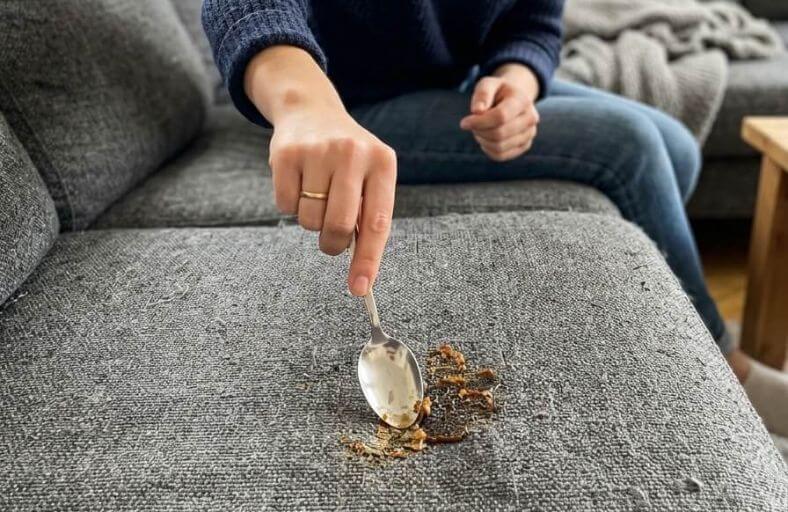
Instead, use a blunt-edged tool such as a spatula or a spoon to lift solid matter away from the surface in a vertical motion.
Once solids are removed, focus on high-efficiency blotting. Use un-dyed microfibers or paper towels to apply firm, steady pressure directly onto the spill.
This encourages vertical wicking, drawing the liquid solutes upward and out of the textile layers.
| Action | Tool | Purpose |
| Scraping | Spatula or Spoon | Removes solids without spreading |
| Blotting | Microfiber Cloth | Wicks moisture out of fibers |
| Extraction | Wet-Vac | Pulls liquid from deep foam |
For high-volume spills, a wet-vacuum is superior to manual blotting, as it utilizes negative pressure to pull moisture from the sub-surface layers of the cushion.
Baking Soda Desiccation
Baking soda is a versatile neutralizing agent with a pH of approximately 8.0, making it the perfect adversary for the acidic remnants of emesis.
When applied to the affected area, it initiates a chemical reaction that converts strong, pungent acids into odorless salts.
Beyond chemistry, baking soda acts as a powerful desiccant, drawing residual moisture out of the couch’s internal foam matrix to prevent microbial proliferation.
For the best results, apply a generous, thick layer of powder, about a quarter-inch deep, completely covering the impact zone.
You must allow the powder to sit for several hours, or ideally overnight, to facilitate the full transfer of moisture and gases into the bicarbonate.
Once the powder has dried into clumps, remove it using a high-suction vacuum with an upholstery attachment.
White Vinegar Mist
While vomit is initially acidic, the subsequent bacterial decomposition of proteins can lead to the formation of alkaline byproducts like ammonia.
Distilled white vinegar, containing roughly 5% acetic acid, acts as a secondary neutralizer that disrupts the molecular structure of these sour odors.
It also serves as a mild disinfectant to kill odor-producing bacteria on the fabric surface.
Mix a solution of equal parts white vinegar and warm water in a spray bottle. Lightly mist the area, being careful not to over-saturate, and allow it to dwell for 10 to 15 minutes.
For sensitive materials like leather or microfiber, always perform a spot test in an inconspicuous area first to ensure the acid doesn’t affect the dye or texture. Blot the area dry with a clean cloth after the dwell time.
Bio-Enzymatic Remediation
Traditional detergents often fail because they cannot break down the complex protein chains and lipids found in gastric bile. For a professional-level clean, enzymatic treatments are mandatory.
These biological cleaners contain proteases (to digest proteins) and lipases (to target fats), which physically eat away the organic source of the smell rather than masking it with perfume.
Products like Biokleen Bac-Out or Nature’s Miracle contain live bacterial cultures that continue working for up to 72 hours as long as the area remains damp.
To use effectively, saturate the spot generously, ensuring the liquid reaches the same depth as the original spill.
Cover the area with a moist cloth to maintain the hydration levels needed for the enzymes to stay active. This deep-digestion process is the only way to truly eradicate odors trapped in the foam core.
The Hydrogen Peroxide Oxy-Mix
When biological stains persist, an unbeatable DIY oxygenated recipe often provides the final knockout blow.
This mixture consists of 2 cups of 3% hydrogen peroxide, 2 tablespoons of baking soda, and 2 drops of liquid dish soap.
This formula creates a synergistic reaction where oxygen radicals physically dismantle odor-causing molecules and destroy underlying bacteria.
It is particularly effective for removing the “ghost” of a stain that standard soaps leave behind.
To apply, mist the solution over the affected area and allow it to air dry naturally. As the peroxide works, it may bubble, which is a sign that it is actively oxidizing the organic matter.
However, material safety is paramount. Since peroxide has mild bleaching properties, you must test it on a hidden corner of your couch to ensure it won’t strip the dye. Once dry, any leftover white residue from the baking soda can be easily vacuumed away.
Thermal Steam Extraction
For deep-seated contamination that has migrated into the internal architecture of your furniture, topical treatments might fall short.
Thermal extraction using a steam cleaner is the professional standard for sanitization.
High-temperature steam near 200°F liquefies congealed fats and lipids while thermally killing odor-producing bacteria without harsh chemicals.
Before starting, verify your upholstery care code; only proceed if it says “W” or “WS”.
| Step | Professional Technique | Benefit |
| Verification | Check “W” or “WS” tags | Prevents fabric damage |
| Motion | Constant movement | Prevents mold growth |
| Finishing | High-velocity fans | Ensures safe drying |
Hold the nozzle approximately one inch away from the fabric and limit dwell time to 2 or 3 seconds per spot to avoid soaking the internal foam.
Excess moisture in the foam core can lead to secondary problems like mildew. Always use a microfiber towel to blot away loosened dirt immediately after steaming each section.
Atmospheric Adsorbents
Even after the spill is physically gone, malodorous gases can linger in the air or be absorbed by nearby surfaces.
Passive atmospheric deodorizers like activated charcoal and dried coffee grounds are excellent natural adsorbents.
Coffee grounds are especially clever because they contain nitrogen, which helps neutralize sulfur-based and nitrogenous smells rather than just masking them.
To use this hack, spread used grounds on a baking sheet to dry completely to prevent mold. Place the dry grounds in a breathable container, like a bowl or a tied-off sock, and set it near the couch for several days.
Activated carbon works similarly through physical adsorption, where its massive internal surface area traps volatile organic compounds within microscopic pores.
These methods provide a safe, non-toxic way to clear the room’s atmosphere after the cleanup is finished.