Tile floors are beautiful, durable, and easy to clean, but they are also notoriously slippery surfaces for area rugs, which tend to shift, slide, and bunch with even the lightest foot traffic.
If you have ever stepped onto a rug and felt it skate across your tile floor, you already know how unsettling and potentially dangerous that experience can be.
Getting a rug to stay put on tile requires a more targeted approach than simply placing it and hoping for the best.
These tips walk you through the most reliable solutions available, helping you choose the right method for your specific rug type, tile surface, and household situation.
Dual-Surface Non-Slip Rug Pads
Dual-surface non-slip rug pads are widely considered the gold standard for stabilizing rugs on tile surfaces. For tile floors, experts recommend a specific construction: a combination of felt and natural rubber.
The natural rubber side is placed face-down to grip the tile, while the felt side faces up to grab the rug’s backing.
Natural rubber is the preferred material because it provides maximum grip without sticking to the floor or leaving permanent “nicotine” stains often caused by cheap PVC alternatives.
To install, trim the material so it is 1 to 2 inches shorter than the rug on all sides. This ensures the pad remains hidden while allowing the rug edges to taper down to the floor, significantly reducing trip hazards.
Adhesive-Based Rug Grippers
Adhesive-based rug grippers and corner anchors offer a targeted solution for rugs that suffer from curling corners or minor shifting.
These are typically small patches or strips applied to the underside of the rug’s corners to create friction between the floor and the textile.
Many modern grippers are reusable and can be repositioned as needed; simply wiping the adhesive surface with a damp cloth reactivates the grip once it becomes dusty.
| Feature | Corner Grippers | Full-Size Rug Pads |
| Primary Goal | Prevent corner curling | Overall stability and cushion |
| Installation | Corners and edges only | Entire rug footprint |
| Reusability | High (washable) | Medium |
This flexibility makes them an attractive option for households that require frequent cleaning under rugs.
By anchoring the corners specifically, they prevent the “bunching” that leads to most household tripping incidents.
Double-Sided Rug Tape
Double-sided rug tape provides a fast and inexpensive method for securing rugs, especially runners in high-traffic hallways.
This tape is designed with a strong adhesive on one side for the rug and a non-slip surface for the floor.
However, it is vital to select silicone-based tapes rather than those with harsh polyethylene resin adhesives, which can disintegrate and leave stubborn residues on your tiles.
Before application, both the floor and the rug backing must be thoroughly cleaned and dried to ensure a proper bond.
Because the adhesive properties often diminish after one use, tape is generally considered a short-term solution that requires replacement whenever the rug is moved for deep cleaning.
DIY Silicone Caulking Friction Strips
For a truly custom fix on a budget, look no further than your local hardware store’s plumbing aisle. Applying 100% silicone caulk to the underside of a rug is a brilliant DIY trick for textiles that just won’t stay put.
You simply turn the rug over and use a caulking gun to draw thin, squiggly lines or small dots across the backing. It is important to flatten these beads slightly with a putty knife so they do not feel like hard lumps under your feet once they are dry.
Once the silicone cures completely, which usually requires a full 24 hours, it transforms into a rubbery, high-friction surface that grips the tile firmly.
This method is exceptionally effective for small mats in bathrooms or kitchens where moisture often makes other adhesives fail.
However, keep in mind that this is a permanent modification. While it is perfect for inexpensive or synthetic rugs, you should avoid using it on valuable heirlooms or antique pieces that require professional care.
Strategic Furniture Anchoring
Sometimes the simplest solution is also the most cost-effective. Strategic furniture anchoring involves using the heavy pieces you already own to pin your rug to the tile floor.
By placing the legs of a sofa, a heavy coffee table, or a dining set over the edges of the rug, you use gravitational force to prevent lateral sliding. This method is ideal for large area rugs in living rooms where the layout is relatively permanent.
To maximize the effectiveness of this approach, try to ensure at least two legs of each furniture piece are resting on the rug.
For even better results, combine this with a thin rug pad to protect the fibers from being crushed between the heavy furniture and the hard tile.
While this is a free fix, it mainly secures the areas directly under the weight. The unanchored centers of very large rugs might still bunch up if they are thin, so keep an eye on high-traffic pathways.
Repurposed Rubberized Shelf Liners
If you need a low-profile solution for a thin runner or a small mat, reach for a roll of rubberized shelf liner. These mesh liners, typically used to keep plates from sliding in kitchen cabinets, provide surprising traction on slick tile floors.
They are incredibly affordable, often costing under 12 a roll, and can be easily trimmed with standard household scissors to fit any rug shape.
| Method | Best For | Cost | Longevity |
| Silicone Caulk | Inexpensive or Synthetic rugs | Low | Long-term |
| Furniture Anchoring | Large area rugs | Free | Permanent |
| Shelf Liners | Thin runners or Mats | Low | Short-term |
Because they are made of a cushioned, grippy material that works through friction alone, they will not leave any chemical residue or sticky stains on your beautiful tiles . However, shelf liners are generally considered a temporary or short-term fix.
They lack the structural density of professional rug pads and may begin to compress or lose their grip after a year or two of heavy foot traffic.
They are the perfect “right now” solution for renters or anyone on a budget who needs an immediate safety upgrade without the bulk of a traditional pad .
High-Cycle Hook-and-Loop (Velcro) Anchoring Systems
Velcro or hook-and-loop strips provide a durable and long-lasting solution that allows for the rug to be detached and reattached multiple times. This system involves sticking one side of the adhesive strip to the tile and the corresponding side to the rug backing.
When the two sides are pressed together, they create a strong mechanical bond that prevents any lateral sliding.
This method is particularly advantageous for high-traffic entryways where rugs need to be taken outside for frequent shaking or cleaning. Because the bond is mechanical rather than purely adhesive, it can withstand significantly more force than standard rug tape.
However, ensure the adhesive backing on the Velcro strips is “surface-safe” for tile. Some industrial-grade adhesives can be difficult to remove from tile grout and may leave residue on porous natural stone like marble or travertine.
Anti-Slip Friction Sprays and Topical Treatments
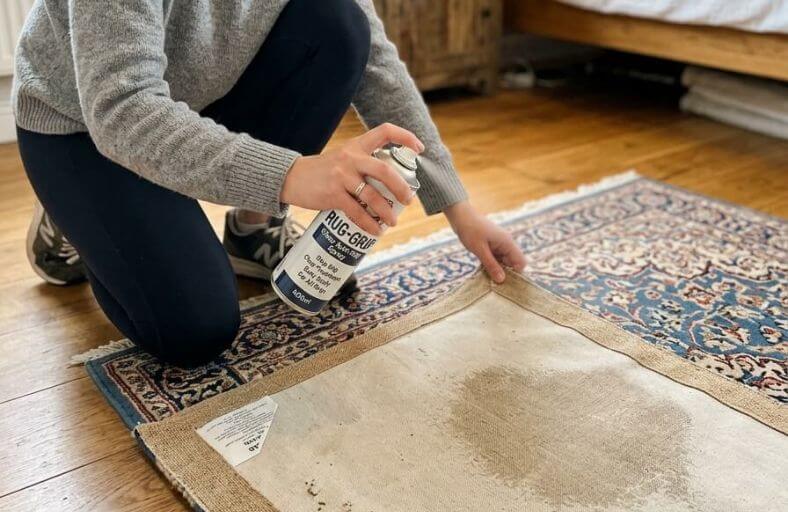
Rug gripper sprays are a modern innovation that allows for the application of a thin, tacky film to the underside of a rug.
These sprays are applied in a manner similar to spray paint, creating a uniform layer of friction across the entire backing of the textile. Once dry, the spray prevents the rug from sliding while remaining invisible from the top.
While less permanent than silicone caulk, the grip provided by sprays is generally lighter and may need to be reapplied after the rug is washed or after heavy use.
Sprays are ideal for small, decorative rugs that are not subjected to heavy “sliding” forces, such as those in a bedroom or home office.
It is essential to ensure the spray is fully cured before placing the rug on the tile; otherwise, wet spray can act as a permanent adhesive, effectively gluing the rug to your floor.
Thermal-Bonded Traction Points
For a quick, DIY fix on synthetic rugs, a simple hot glue gun can be used to create small traction points or “treads”.
This involves applying dots or lines of glue to the rug backing. Much like silicone, the cooled glue provides a rubberized surface that increases friction against the tile.
The primary drawback of hot glue is its lack of flexibility; as the glue ages, it can become brittle and crack, potentially losing its bond with the rug. Furthermore, because hot glue is applied as a thick liquid, it can create uneven spots that are felt through thin rugs.
This method is best reserved for small rugs where the goal is a fast finish rather than long-term structural integrity. Experts warn that hot glue should never be used on natural fiber rugs like wool or silk, as the heat can damage the delicate fibers.
Integrated Non-Slip Backing Rug Selection
The most comprehensive “low-effort” solution is to purchase rugs manufactured with an integrated non-slip backing.
These rugs often feature a layer of latex, rubber, or thermoplastic elastomer (TPE) molded directly onto the underside.
| Backing Material | Characteristics | Best Use |
| Latex | Very grippy and flexible | Bathrooms and kitchens |
| TPE | Durable and eco-friendly | High-traffic hallways |
| Natural Rubber | Maximum friction | Entryways and heavy traffic |
Because the non-slip element is part of the rug’s construction, there is no need for separate pads or adhesives.
Substrate Friction Maintenance and Cleaning Protocols
The effectiveness of any non-slip solution is heavily dependent on the cleanliness of the tile surface itself. Dust, pet hair, and microscopic debris act like tiny ball bearings, allowing even the best rug pads to slide over the tile.
Regular maintenance is essential; you should lift the rug and pad at least once a month to vacuum or sweep the underlying floor to restore the “tackiness” of the setup.
Furthermore, your choice of cleaning chemicals is critical. Wax-based cleaners or certain “all-in-one” floor polishes can leave a slippery residue that fills the microscopic pores of the tile, significantly lowering the coefficient of friction.
For tile floors, it is best to use a pH-neutral cleaner that removes grease and soap scum without leaving a film.
If a rug continues to slide despite a high-quality pad, a build-up of floor wax or cleaning residue might be the culprit, requiring a deep strip-clean to restore the floor’s natural grip.
Permanent Micro-Etching Surface Treatments
In areas with extreme slip risks, such as large tiled foyers or bathrooms, a professional micro-etching treatment can be applied to the tile itself.
This process involves a specialized chemical solution that works with the minerals in porcelain or stone to create thousands of microscopic “suction cups” on the surface.
This treatment is virtually invisible and does not change the aesthetic appearance of your tile, but it dramatically increases slip resistance when the floor is wet or when a rug is placed over it.
Unlike mats or rugs, which can become trip hazards when their edges curl, micro-etching addresses the root cause: the slick nature of the tile material itself. This is a high-end, professional-grade solution that eliminates the need for bulky rubber mats or sticky adhesives altogether.
Architectural Inlaid Tile Rug Designs
For those undergoing a renovation, the ultimate “aesthetic nightmare” of a sliding rug can be avoided by creating an architectural tile rug.
| Design Element | Tile Rug Implementation |
| Visual Border | Contrasting tile trim or molding |
| Texture | Tumbled stone or matte porcelain |
| Safety | Zero trip hazard and naturally anti-slip |
| Maintenance | Mop only, no vacuuming needed |
This involves installing an inset of patterned or textured tile that is laid flush with the surrounding floor.
By using decorative mosaics, herringbone patterns, or contrasting colors, the illusion of a rug is created within the permanent flooring.