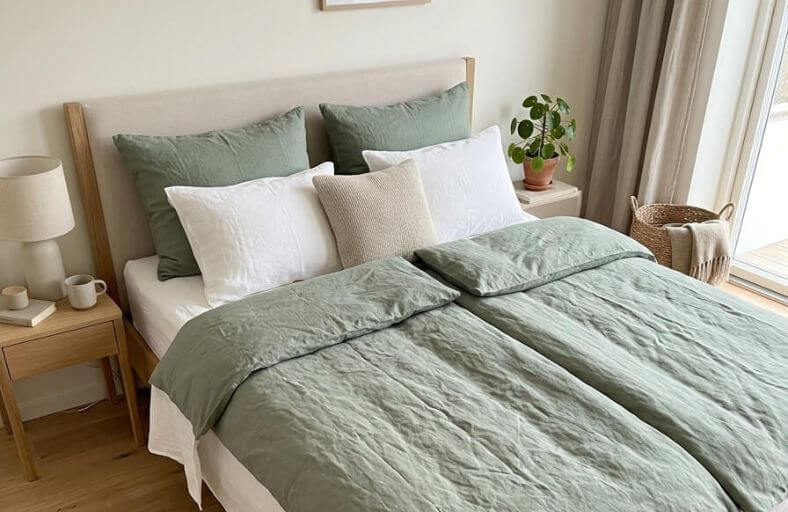
There’s a reason hotel beds feel so impossibly comfortable. It’s not magic, it’s method.
The good news is that recreating that same plush, deeply cozy feeling in your own bedroom is entirely achievable without a hotel budget or a professional interior designer.
Coziness comes from layering the right bedding, choosing materials that feel good against your skin, and paying attention to a few key details that most people tend to overlook.
Whether your bedroom is large or small, your style minimal or maximalist, the same core principles apply.
Mattress Protectors and Ergonomic Anchoring
Every designer-level bed starts with a silent yet critical layer: the mattress protector. It is the “Layer 0” that creates a hygienic barrier while providing a smooth surface for your sheets. Without it, even the finest linens can feel bunchy or uneven.
Beyond the mattress, ergonomic anchoring involves placing a textured rug beneath the bed frame. This creates a tactile transition zone, ensuring your feet touch a soft surface rather than a cold floor when you wake up.
Designers suggest a rug should extend at least 8 to 10 inches past the bed to ground the space effectively. This foundation ensures that your cozy experience begins the moment you enter the room.
High-Staple Fibers
The base layer is the only part of your bed that stays in constant contact with your skin, making fiber quality non-negotiable. Professionals always look for long-staple or extra-long-staple fibers, such as Egyptian or Pima cotton.
These fibers are spun into smoother, stronger yarns that resist pilling and skin irritation. For those who move a lot during sleep, low-friction fabrics like bamboo or Tencel are ideal because they glide against the body, preventing micro-awakenings caused by bunching.
Choosing a neutral tone for this base layer keeps the aesthetic calm and allows for easier layering later.
Thermal Engineering
Thermal regulation is the cornerstone of a restful sleep system. Your body needs to cool down to enter deep sleep, so choosing the right weave for your environment is vital.
| Material | Weave Style | Best For | Sleep Feel |
| Percale | One-over, one-under | Hot sleepers | Crisp and matte |
| Sateen | Four-over, one-under | Cold sleepers | Silky and warm |
| Linen | Loose flax weave | Humid climates | Breathable and relaxed |
Percale offers a “just-pressed” freshness that is highly breathable. Sateen, however, provides a luminous sheen and a heavier drape for those who love feeling cocooned.
Linen remains a timeless favorite because it softens with every wash while maintaining exceptional airflow.
Hospitality Tuck and Hospital Corners
To achieve that crisp, high-end hotel look, you must master the hospitality tuck and hospital corners. This technique involves using a flat sheet instead of a fitted one to create a drum-tight foundation.
After centering the sheet, you tuck the bottom edge and fold the corners at a precise 45-degree angle before securing the side flaps. This tension prevents the sheets from shifting or wrinkling throughout the night, which maintains a smooth sleeping surface.
It is a simple step that transforms a casual bed into a polished, five-star sleep sanctuary while signaling a high standard of hygiene.
Volumetric Design
Triple sheeting is a strategic layering method used by luxury hotels to create a plush, cloud-like bed that is both comfortable and efficient to maintain. This system uses three layers of sheets to encase a middle warming layer, such as a thin blanket or a lightweight quilt.
The structure consists of a fitted sheet, a middle flat sheet, the warming blanket, and finally a top flat sheet to protect the blanket from dust and skin oils.
The primary advantage of this method is hygiene and ease of laundering. Because the middle blanket is protected on both sides by sheets, it requires less frequent washing than a traditional duvet cover, which can be cumbersome to manage.
From a design perspective, triple sheeting allows for a highly tailored look, as the top sheet can be folded back over the blanket to create a crisp, white border that showcases the bed’s cleanliness.
Loft Manipulation
The duvet is the focal point of the cozy bed, providing the essential volume and visual softness that makes a bedroom feel inviting. To achieve the “cloud effect” seen in high-end design magazines, professionals often employ “loft manipulation” tricks.
One popular method is the “Sizing Trick,” which involves using a duvet insert that is one size larger than the duvet cover (e.g., a King insert inside a Queen cover). This forces the fill to compress slightly, creating an over-stuffed, high-volume appearance.
For ultimate luxury, some professionals use the “Double Stuffing” technique, placing two lightweight duvet inserts inside a single cover to provide unparalleled loft. Regardless of the insert choice, a critical maintenance step is the “Daily Fluff.”
Shaking the duvet each morning redistributes the fill and re-introduces air into the clusters, maintaining the bed’s inviting shape throughout the day.
Scandinavian Sleep Method
In shared beds, the conflict between individual thermal preferences and the desire for closeness often leads to disrupted sleep. The Scandinavian Sleep Method offers a practical solution by replacing one large duvet with two separate, single-size duvets.
This method, standard in Northern Europe, prioritizes individual autonomy while maintaining a cohesive aesthetic.
By using two duvets, each partner can customize their bedding to their specific needs—one can choose a heavy down fill while the other opts for a lightweight cooling material. Furthermore, this method eliminates “cover stealing” and significantly reduces motion transfer.
To maintain a unified look during the day, the two duvets are typically laid flat side-by-side, and a large decorative throw or runner is placed across the foot of the bed to bridge the gap and ground the design.
Intermediate Texturing
To prevent a bed from looking flat or clinical, designers introduce intermediate layers between the sheets and the duvet. These layers, such as quilts, coverlets, and matelassé, provide both functional warmth and visual depth through texture.
Matelassé is a specific weaving technique that creates a quilted appearance without actual padding, resulting in a sophisticated, three-dimensional texture.
| Layer | Weight | Primary Function | Texture Feel |
| Quilt | Heavy | Warmth and tradition | Stitched and cozy |
| Coverlet | Light | Decorative streamlining | Thin and smooth |
| Matelassé | Moderate | Dimensional depth | Woven and 3D |
Mixing these textures, such as a smooth sateen sheet with a waffle-weave coverlet, creates a tiered aesthetic that feels curated and intentional.
Professionals often follow the “Rule of Three”: a solid base, a subtle texture in the middle, and a bold accent on top.
Geometric Proportions
A perfectly made bed is as much about what is hidden as what is revealed. Professional stylists use the “1/3 Rule” to create balanced proportions and invite the sleeper into the bed.
This technique involves taking the top sheet and the mid-layer (like a quilt or coverlet) and folding them back toward the foot of the bed by approximately one-third of the mattress length.
This “turn-back” creates a tiered look that breaks up the large surface area of the bed and reveals the contrasting textures of your base layers. To execute this like a pro, place your top sheet pattern-side or “finished” side down on the bed.
This ensures that when you fold it back, the most beautiful side of the fabric is visible against the duvet, serving as a visual cue of “readiness” that makes the bed feel welcoming rather than closed off.
The Structural Anatomy of Pillows
Pillows are the primary architectural elements of a cozy bed, and their arrangement dictates the room’s mood. Designers typically use a hierarchy of sizes and functions to build volume at the head of the bed.
| Pillow Type | Position | Primary Function |
| Euro Sham | Back | Provides height and headboard support |
| Sleeping Pillow | Middle | Ergonomic core for actual sleep |
| Standard Sham | Front | Adds texture and matches the duvet |
| Accent/Lumbar | Focal Point | Introduces bold patterns or textures |
You can choose between two main arrangements: “The Stack,” where pillows are laid flat for a clean, contemporary look, or “The Lean,” where they are propped upright against the headboard to create depth and hotel-luxe volume.
Mixing textures, such as velvet accent pillows against cotton shams, adds visual interest without clutter.
Tactile Grounding
The final aesthetic layer of a cozy bed is the throw blanket, which is strategically placed at the foot of the bed to “ground” the entire look. This element introduces a final pop of texture and serves as a functional layer for quick naps or extra warmth.
Stylists typically use one of two methods: “The Drape” or “The Runner.” For “The Drape,” a textured throw is tossed casually over one corner of the foot of the bed, creating a relaxed, “lived-in” feel.
“The Runner” involves folding the throw into a neat rectangle across the width of the mattress for a more formal, tailored appearance. To maximize the cozy factor, choose a material that contrasts with your duvet, such as a chunky knit, faux-fur, or a heavy-gauge wool blanket.
Harnessing Color Theory
The color palette of your bedding is a powerful tool for emotional regulation and sleep preparation. Environmental psychology suggests that cool tones, such as soft blues, muted greens, and lavenders, are associated with calmness and can help lower the heart rate.
Neutral tones like cream, beige, and soft grey are also preferred because they reduce cognitive load, allowing the brain to decompress before sleep.
When building your palette, follow the “Rule of Three”: choose a primary neutral for the main sheets, a secondary tonal color for the shams or quilts, and a single bold accent for your decorative pillows.
Avoid high-contrast patterns or “visually loud” colors, as these can signal “unfinished business” to the brain and keep you in problem-solving mode instead of rest mode.
Atmospheric Optimization
Atmospheric optimization is the invisible layer of a cozy bed. Your brain requires specific environmental cues to trigger the “rest mode” transition.
Lighting management is the first step: 60 to 90 minutes before bedtime, switch from harsh overhead lights to warm-toned bedside lamps (approximately 2700K). This shift signals the body to prepare for rest and supports your natural circadian rhythm.
Temperature regulation is equally vital. Research indicates that a bedroom temperature between 60-67°F is optimal for consolidated, uninterrupted sleep. Finally, incorporate olfactory cues. Spritzing your pillow with lavender spray creates a sensory anchor.
The scent of lavender has a direct relaxing effect on the nervous system, training your mind to associate that specific aroma with the safety and comfort of your bed.
Cognitive Load Reduction
Visual clutter is the primary enemy of a restful mindset. Environmental psychology shows that when your eyes scan a room and find laundry piles or work laptops, your brain stays in “problem-solving” mode.
To maximize the cozy feeling of the bed, you must reduce the cognitive load of your immediate surroundings.
Adhere to the “Three-Item Rule” for your nightstand: one lamp, one bottle of water, and one calming item like a journal or book. Remove all “decision objects” from your line of sight, anything that asks something of you or reminds you of daily tasks. Sit on your bed and identify your “last view.”
This should be a calm, repeatable sight, such as an empty wall, a piece of soft art, or a warm lamp glow, which serves as a nightly shutdown cue for your brain.
Seasonal Calibration
A truly cozy bed is an evolving system that adapts to the seasons. This calibration ensures that your micro-climate remains perfect for sleep year-round, whether it is mid-winter or the peak of summer.
| Season | Recommended Materials | Layering Strategy |
| Winter | Sateen or Flannel | Double-stuff duvets; heavy wool or faux-fur throws |
| Summer | Percale or Linen | Lightweight coverlets; moisture-wicking bamboo |
During winter, focus on insulation by adding a second duvet insert or using heavier textures like velvet to create a sense of warmth. In summer, prioritize “venting” layers over “insulating” ones.
Swap heavy comforters for breathable cotton quilts or thin matelassé layers that allow heat to escape instead of pooling under you. By rotating your fabrics, you maintain a sanctuary of comfort regardless of the temperature outside.