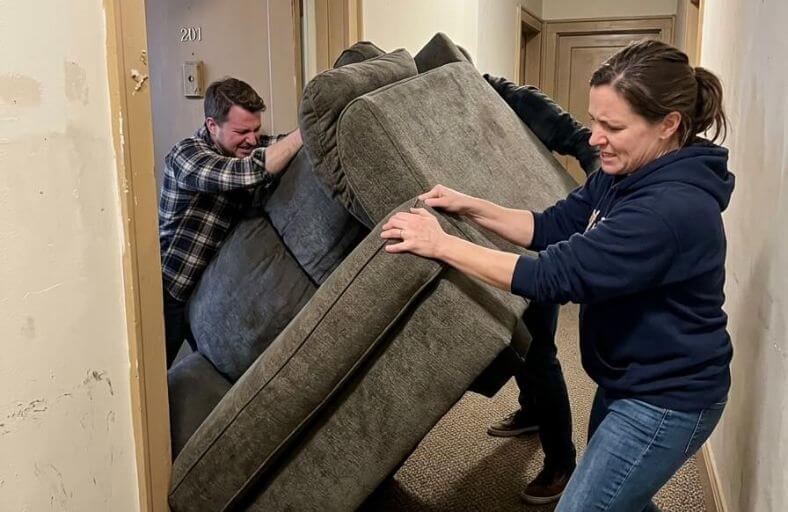
Moving a couch is one of the most physically demanding home tasks most people tackle without any real preparation.
And that lack of preparation is exactly why so many moving-day injuries and floor scratches happen. A couch is bulky, awkward to grip, and often heavier than it looks.
Getting it from one room to another, or out of the house entirely, requires a clear plan, the right tools, and an understanding of basic furniture-moving techniques that protect both the sofa and the people carrying it.
These practical tips give you a clear, step-by-step approach to moving a couch of any size safely, efficiently, and without damaging your home in the process.
Dimensional Audit
The most common moving failure happens before a single person lifts the furniture.
Professional movers rely on data-driven assessments rather than visual estimates to identify leading edges, which are the furthest possible points for every dimension: length, width, height, and depth.
You must measure the total envelope of the sofa, including protrusions like flared armrests or fixed legs that may not align with the frame’s footprint.
Equally important is measuring the minimum effective clearance of your entire route. Do not just measure the door opening; account for doorknobs, hinges, and stop moldings inside the jamb, which can reduce the effective width by up to two inches.
If your path involves a 90-degree turn, the length of the sofa becomes the critical factor, as the piece must be able to rotate within the hallway’s width.
Use the table below to verify your clearances before you start.
| Feature to Quantify | Furniture Metric | Threshold Constraint | Strategic Relevance |
| Horizontal Clearance | Maximum Depth (D) | Doorway Width (W) | Determines if the piece passes in standard orientation. |
| Vertical Clearance | Maximum Height (H) | Doorway Height | Critical for “end-on” or vertical maneuvers. |
| Diagonal Passage | Diagonal Depth | Doorway Width/Height | Calculates the minimum space for an angled or tilted approach. |
| Turn Radius | Total Length (L) | Hallway Width/Corner | Determines if the piece can rotate 90 degrees in a corridor. |
Structural Disassembly
If your measurements suggest a tight fit, disassembly is your first line of defense. Professional protocols view a sofa as a modular assembly rather than a single block.
Begin by removing all soft goods like cushions and pillows to reduce bulk and expose the internal frame.
For sleeper sofas, removing the mattress is mandatory: this single step can shed 40 to 60 pounds and significantly lower the center of gravity.
Next, target the legs. Most modern sofa legs use standard M8 or 5/16-inch threaded bolts and can be unscrewed manually by rotating counter-clockwise.
Removing even four-inch legs is often the difference between a successful horizontal pass and a complex vertical maneuver.
For more complex pieces like recliners, look for locking levers in the rear seams: flipping these up allows the heavy backrest to slide off its tracks, cutting the weight and volume of the piece by nearly half.
Always store all hardware in a labeled bag and tape it directly to the frame to avoid losing critical screws during the move.
Surface Armor Strategy
Protecting your home’s surfaces is just as important as protecting the furniture itself. Damage to walls and floors can lead to expensive repairs or the loss of a security deposit.
For hardwood or tile floors, do not rely on plastic sheeting, as it creates a dangerous slip hazard for the moving team. Instead, lay down red rosin paper, Masonite boards, or professional floor runners in high-traffic corridors.
These materials act as shock absorbers and prevent the gouging that occurs if a heavy piece is accidentally dropped.
Walls, especially corner edges, are highly vulnerable during 90-degree turns. Install foam or plastic corner guards on the walls along your route.
You should also encapsulate the sofa in heavy-duty moving blankets, securing them with stretch wrap.
This armor prevents the fabric from snagging and ensures that any accidental bumps against the wall do not result in deep scuffs or paint chips.
For extremely tight doorways, you can even apply foam tubing to the door frame to provide a soft, shock-absorbing buffer.
Mechanical Advantage
Relying on brute force is a rookie mistake that leads to exhaustion and property damage.
Professional movers prioritize mechanical advantage by using tools that substitute leverage for biological exertion.
For long hallways or flat surfaces, the four-wheel furniture dolly is your best friend. By centering the couch’s weight over the wheels, one person can navigate a heavy piece that would otherwise require three.
When it comes to room repositioning, furniture sliders are non-negotiable. These small discs reduce the coefficient of friction, allowing a couch to glide across the floor with a simple push.
However, you must choose the right slider for your specific surface to avoid damage.
| Tool Type | Floor Surface | Primary Benefit |
| Hard Plastic Sliders | Carpeted floors | Glides over fibers without snagging. |
| Felt-Bottom Sliders | Hardwood, tile, or laminate | Prevents scratches and finish scuffing. |
| 4-Wheel Flat Dolly | Any level surface | Eliminates the need to carry weight. |
| Appliance Dolly | Stairs or heavy sleepers | Features straps for vertical control. |
Biomechanical Lifting
If you must lift, you must do so within the Power Zone, the space between your mid-thigh and mid-chest where your body is strongest and most stable.
Maintaining the natural arch of your spine and engaging your core muscles prevents the lumbar vertebrae from taking the brunt of the load.
A critical rule of professional moving is “nose between your toes”: never twist your torso while under a load.
If you need to change direction, pivot your entire body with your feet rather than rotating your waist.
For a significant ergonomic upgrade, use shoulder dolly systems or forearm forklift straps.
These tools redistribute the weight from your relatively weak hands and arms to your large muscle groups like the trapezius and legs.
This not only makes the couch feel 50% lighter but also keeps your hands free to steady the piece or balance yourself against a wall during transit.
Architectural Navigation
The most difficult part of the move is the geometric conflict between the couch and your home’s architecture. To solve this, professional movers utilize the “Hook Maneuver” (or L-method).
Instead of approaching a doorway head-on, tilt the couch so the backrest leads, hook one arm through the door, and then rotate the piece in a fluid “L” motion.
If the doorway is too narrow for a horizontal pass, standing the couch vertically is often the only solution, provided your ceilings are high enough.
Staircases require a specialized High-Low strategy. The stronger mover should always take the low end (the side further down the stairs), as they will bear approximately 70% of the total weight due to the tilt.
Constant communication is essential here; use simple, clear commands like “Up,” “Stop,” or “Pivot” to ensure both movers are in sync.
Never rush the descent, and use the “tilt angle” to ensure the couch doesn’t bottom out against the stair treads or railings.