A disorganized bedroom affects you more than you might realize. It makes mornings more stressful, evenings less restful, and the room itself feel smaller and more chaotic than it needs to be.
The good news is that getting a bedroom properly organized does not require a full renovation or an expensive storage system.
It starts with a few clear decisions about what belongs in the room, where everything should live, and how to set up simple systems that are easy to maintain over time.
These tips give you a friendly, practical framework for organizing any bedroom, regardless of its size, in a way that genuinely improves how the space looks and feels every single day.
Nightstand Functional Minimization
Your nightstand is the closest thing to your eyes before you drift off, making it the most critical surface to clear.
A cluttered bedside table overloads your visual cortex, forcing your brain to process unfinished tasks instead of winding down.
To fix this, stick to the rule of three: a lamp, a water glass, and a single book for pleasure reading.
Small items like jewelry, lip balm, or glasses should be contained within a small tray or dish to prevent visual creep across the surface.
If you have no room for a traditional table, a wall-mounted picture ledge or a floating shelf can provide just enough space for these essentials without crowding the floor.
By keeping this area strictly for rest, you signal to your brain that the day is officially over.
Floor Plane Reclamation
A floor covered in laundry baskets, stray shoes, and discarded bags creates “decision fatigue” before you even wake up.
Your brain subconsciously registers these items as a to-do list, preventing your cortisol levels from dropping naturally in the evening.
Maintaining clear pathways between your bed and the bathroom is essential for safety and psychological calm. Every item on the floor must find a vertical home or be hidden away.
For instance, laundry belongs in a dedicated hamper, ideally tucked inside a closet, and shoes should be moved to over-the-door racks or vertical shelves.
Even when your eyes are closed, knowing the floor is clear allows your parasympathetic nervous system to take over, ensuring a deeper and more restorative sleep.
Under-Bed Reservoir System
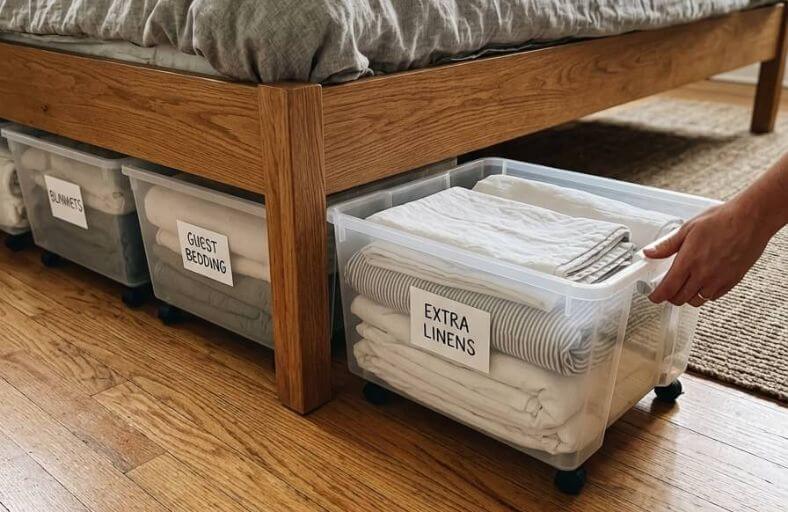
The area beneath your mattress is a massive, often wasted volume that can act as a hidden reservoir for seasonal clutter.
Instead of letting dust bunnies and random objects take over, use structured storage to keep things organized.
Clear, shallow bins with wheels are perfect for items you need occasionally, like extra linens or guest towels.
If your bed is too low, inexpensive bed risers can instantly create the height needed for deeper containers.
Labeling each bin ensures you never have to dig through multiple boxes, which prevents the frustration that leads back to mess.
| Container Type | Best For | Storage Benefit |
| Rolling Bins | Shoes/Seasonal Clothes | Easy access for frequent items |
| Vacuum Bags | Comforters/Winter Coats | Saves up to 75% more space |
| Fabric Bins | Extra Bedding/Linens | Breathable and aesthetic |
Ottoman and Lift-Up Storage Beds
For the ultimate space-saving maneuver, an ottoman bed is the professional’s choice.
These frames feature a hydraulic lift mechanism that allows the entire mattress to be raised, revealing a vast, dust-free compartment within the base.
Unlike standard under-bed bins, an ottoman bed provides a closed loop system where storage is completely invisible from the outside.
This is perfect for bulky items like camping gear, spare duvets, or luggage that would otherwise clutter a closet.
By concealing these large volumes, you maintain a minimalist atmosphere even in a small room, which helps keep stress levels low and sleep quality high.
Vertical Expansion with Floating Shelves
Professional organizers always look to the walls when the floor is full. Floating shelves are a magic wand for small bedrooms because they provide storage without the heavy footprint of a traditional bookcase.
By lifting your decor, plants, or books, you draw the eye upward, creating an illusion of height and openness in the room. To truly maximize this effect, swap out your bedside lamps for wall-mounted sconces.
This floating setup clears your nightstand surface completely, leaving room for only your absolute rest-related essentials.
It is a sleek, high-efficiency design trick that turns a cramped wall into a functional gallery while keeping the floor plane clear and easy to navigate.
Back-of-Door Organizational Modules
The back of your bedroom or closet door is an overlooked goldmine for storage real estate.
Instead of letting robes or bags pile up on the chair, install an over-the-door rack or a fabric pocket organizer.
This is the perfect landing spot for high-frequency items like shoes, scarves, or accessories that usually end up as surface clutter.
For those who struggle with paper piles on the dresser, a mounted file pocket on the door can catch mail or journals vertically.
This method keeps active tasks contained and visible but strictly off your horizontal surfaces, helping your brain stay in sleep mode rather than “to-do list mode” when you lie down.
Modular Closet Systems and Force Ranking
A chaotic closet is a recipe for morning stress and decision fatigue. To fix this, experts recommend installing a modular system with adjustable rods and shelving to maximize every inch of vertical space.
One of the best hacks is the closet rod doubler, which instantly doubles your hanging capacity for shorter items like shirts or folded pants.
| Component | Strategic Implementation | Storage Benefit |
| Double Rods | Adjust based on clothing length | Doubles hanging capacity |
| Slim Hangers | Velvet or non-slip coating | Saves 50% more space vs plastic |
| Shelf Dividers | Vertical barriers for stacks | Prevents sweaters from toppling |
| Clear Boxes | Uniform, stackable units | Protects shoes and adds visibility |
By force ranking your belongings, placing daily items at eye level and keepsakes on high shelves, you ensure your most frequent interactions with the closet are the most efficient.
Visual Harmony through Uniform Containerization
The human brain is neurobiologically wired to prefer repetition and order. When you open a closet to a sea of mismatched plastic bins, your brain registers visual noise that increases mental fatigue.
Professional organizer Mindy Godding suggests the limit of three rule: use no more than three different finishes or styles in a single space.
Opting for uniform, light-colored bins, especially in dark, windowless closets, creates a cohesive, high-end look that feels more like a boutique and less like a storage unit.
This visual simplification reduces the cognitive load required to find what you need, allowing your mind to exhale at the end of a long day.
Drawer Dividers and Micro-Organization
Drawers often become the black holes of the bedroom where socks, underwear, and small accessories disappear into a jumbled mess.
To prevent this, professional organizers use micro-organization systems like the IKEA STUK or SKUBB series.
By placing adjustable dividers or small fabric bins inside your drawers, you assign a permanent home to every category of clothing.
This level of detail ensures that you never have to dig through piles of fabric, which preserves the order of the system long term.
For jewelry and small valuables, consider using a velvet-lined insert. These organizers not only protect your items but also provide a high-contrast background that makes it easy to find exactly what you need in low-light morning conditions.
When every small item has a designated slot, you eliminate the daily frustration that leads back to surface clutter.
The Basket System for Soft Goods
Baskets are one of the most versatile tools for grouping disparate items while adding a warm, decorative element to your room.
A large woven basket is the perfect solution for containing controlled clutter, such as decorative bed pillows or that half-worn sweater that usually ends up on a chair.
Instead of letting these items scatter across the floor, placing them in a designated basket keeps the visual lines of the room clean.
| Basket Type | Material | Best Used For |
| Woven Seagrass | Natural Fiber | Decorative pillows and throws |
| Fabric-Lined | Cotton/Linen | Delicate linens and spare blankets |
| Wire Mesh | Metal | Active hobby gear or accessories |
Using baskets also facilitates a five-minute sweep before bed. You can quickly toss stray items into their respective bins to instantly restore the visual calm required for your brain to switch into rest mode.
Spatial Zoning
Modern bedrooms often have to pull double duty as a home office, but mixing work and rest can sabotage your sleep hygiene.
Sleep research emphasizes that your bed should be reserved strictly for sleep and intimacy to help your brain maintain a strong association between the mattress and relaxation.
If you must have a desk in the bedroom, use spatial zoning to create a clear boundary.
Position your workspace so it is not visible from the bed, perhaps by using a folding screen, a high bookcase, or a large floor plant as a room divider.
At night, perform a closing ritual by shutting down your laptop and putting all papers away in a drawer or a back-of-door organizer.
Physically hiding your work tasks signals to your parasympathetic nervous system that the professional day has ended, allowing your cortisol levels to drop as you prepare for sleep.
Digital Sanitization and Cable Management
The blue light emitted by electronic devices is a significant disruptor of your circadian rhythm because it suppresses melatonin, the hormone that signals your body to sleep.
Beyond the light, a tangled web of chargers and cables acts as a visual reminder of your always-on modern life, keeping your brain in a state of low-grade alertness.
To fix this, implement a digital sanitization protocol by removing televisions, tablets, and computers from the room.
For the devices you must keep, such as your phone, create a dedicated charging station inside a nightstand drawer or behind furniture to hide the cables.
This physical distance reduces the temptation to browse the internet late at night and ensures your first visual input in the morning is your calm environment rather than a notification screen. By sanitizing your tech, you reclaim your bedroom as a space for recovery.
The One-In, One-Out Protocol
The most successful organizational systems aren’t built on a single cleaning day but on consistent maintenance habits.
To prevent the gradual creep of clutter, professional organizers recommend the “One-In, One-Out” rule.
This protocol is simple: for every new item of clothing, decor, or bedding you bring into the room, an existing item must be donated, recycled, or sold.
This habit ensures that your room’s inventory never exceeds the capacity of your storage systems, preventing the bursting at the seams feeling that causes anxiety.
It forces you to be intentional about your purchases and helps you maintain the minimalist, high-end look you’ve worked hard to create.
Following this rule in every area of your home, especially the bedroom, is the easiest way to ensure you never have to do a hard reset on your organization again.
Seasonal Rotation and Off-Site Storage
A major cause of bedroom congestion is attempting to store four seasons of clothing in a single reach-in closet. By rotating your wardrobe, you can reclaim up to 50% of your closet space instantly.
Out-of-season items, such as heavy winter coats or thick duvets, should be laundered, folded, and placed in marked bins or vacuum-sealed bags.
These can then be moved to less accessible areas like the highest closet shelves or even long-term storage in an attic or under-bed reservoir.
| Habit Type | Frequency | Action |
| Micro-Reset | Daily | Clear nightstand and smooth bed covers |
| Mini-Reset | Monthly | Clear out paper piles or catch-all bins |
| Seasonal Reset | Quarterly | Rotate wardrobe and wash all linens |
This practice ensures that everything currently in your closet is relevant and easy to find, which streamlines your morning routine and reduces mental fatigue.
Sensory and Environmental Optimization
The final layer of organization involves the subtle environmental factors that influence your perception of order.
A room that feels stuffy or smells stale will be perceived as messy, even if the surfaces are tidy.
Clutter often traps dust mites and pet dander, which can lead to poor air quality and respiratory irritation.
Experts suggest washing your bedding at least once every two weeks, or weekly if you share the bed with pets, to remove body oils and allergens.
Additionally, the introduction of calming scents like lavender has been shown to improve sleep quality and help you wake up feeling refreshed.
Finally, ensure that your storage bins do not block windows or vents, allowing for the proper airflow and temperature control, ideally around 65°F (18.3°C), that is critical for deep, restorative sleep.