Shopping for a leather couch can feel like navigating a minefield of misleading labels and convincing imitations.
Terms like “bonded leather,” “PU leather,” and “genuine leather” are used interchangeably in marketing materials, yet they describe very different products with very different lifespans and price points.
Real leather develops a beautiful patina over time and can last for decades with proper care, while faux alternatives tend to peel and crack within a few years. Understanding how to tell the difference gives you real power as a consumer.
These practical tips will equip you with the knowledge to accurately identify real leather on any couch, whether you’re shopping in a store or evaluating a piece you already own.
The Sniff Test
Your nose is actually one of the most reliable tools for authenticating furniture. Authentic leather has a very specific, rich, and slightly musky or oaky aroma that is deeply embedded in the fibers.
This scent comes from the organic nature of the hide combined with the tanning agents used to preserve it.
If you lean in and catch a whiff of something that reminds you of a new car interior, cheap plastic, or strong adhesives, you are likely looking at a synthetic product.
While some manufacturers use leather-scented sprays to mask these odors, those artificial scents are usually one-dimensional and will fade quickly, whereas the smell of real leather remains a permanent part of the piece.
The Fingertip Press
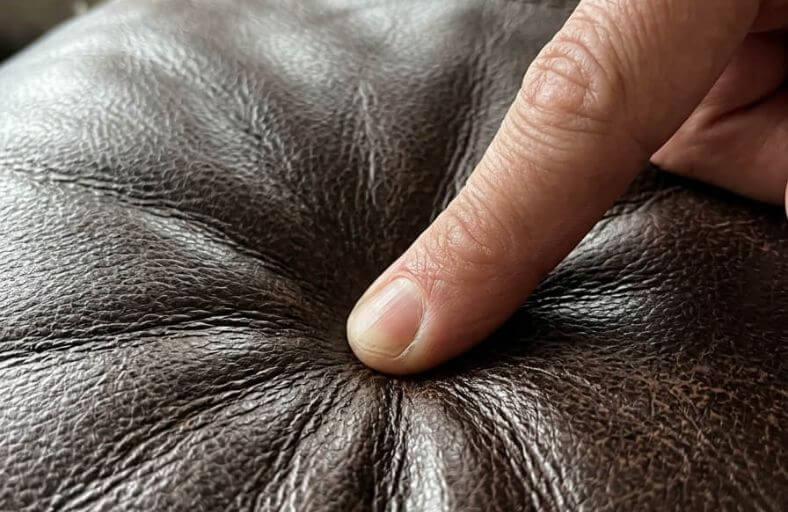
Think of your leather couch like human skin because, biologically, that is exactly what it is. To perform this test, find a flat area of the sofa and press your fingertip firmly into the surface.
On real leather, you will see a network of fine, organic wrinkles radiate out from the pressure point, just like the skin on your knuckles when you bend them. These wrinkles disappear as soon as you release the pressure.
Synthetic materials like PU or PVC are much more rigid; they will simply depress under your finger like a piece of plastic or vinyl, maintaining a smooth, uniform surface without those tell-tale organic stress lines.
The Pore & Grain Inspection
A magnifying glass, or even just a very close look, can reveal the microscopic truth about a sofa.
Real animal hides are filled with pores that once held hair follicles, and these pores are naturally irregular in size and spacing.
Because every animal is unique, the grain pattern on a real couch will never perfectly repeat. In contrast, synthetic leathers are embossed by machines that use large rollers, creating a perfect pattern that repeats every few feet.
| Feature | Real Leather Evidence | Synthetic / Faux Evidence |
| Grain Pattern | Random, non-repeating, stochastic | Perfectly uniform, repeating patterns |
| Pores | Deep, irregular, organic follicles | Shallow, symmetrical, grid-like |
| Flaws | Scars, insect bites, fat wrinkles | Flawless, clinical perfection |
The Moisture Absorption Test
Real animal hide is naturally hydrophilic, meaning it likes to absorb a bit of moisture unless it has been heavily treated with a thick plastic topcoat. To test this, place a tiny droplet of water on an inconspicuous area of the couch.
On authentic leather, the droplet will slowly soak into the material over a minute or two, often leaving a temporary dark spot.
If the water beads up and rolls off like it’s on a rain jacket, you are dealing with a non-porous synthetic like PU or PVC.
This breathability is what makes real leather so comfortable; it allows air to circulate, preventing that sticky feeling on a hot day.
The Temperature & Breathability Test
Real leather is a natural insulator, meaning it quickly adapts to your body temperature. When you sit on it, the material feels warm and inviting almost immediately.
More importantly, because of its porous structure, it breathes, allowing moisture to evaporate instead of trapping it against your skin. Synthetic materials like PVC are non-porous and generally feel cold to the touch initially.
However, because they trap heat, they can become uncomfortably hot and sticky after a short period of use.
If you find yourself peeling your legs off the cushion on a warm day, you are likely sitting on a synthetic polymer rather than a high-quality bovine hide. Authentic leather ensures a comfortable, temperate experience for hours.
The “Under the Hood” Check
If you have access to an inconspicuous area where you can see the back of the material, such as a loose flap at the bottom or near a zipper, take a peek.
Real leather is leather all the way through, and its reverse side will have a rough, fuzzy, suede-like texture.
When you examine a raw edge or a stitch hole, you should see dense, interlocking fibers. In contrast, synthetic leathers are essentially a plastic film glued to a support layer.
If you see a white woven mesh, a fabric backing, or a paper-like substrate, it is a clear sign of a faux or bonded product.
Bonded leather is particularly deceptive as it contains some leather fibers, but it is always adhered to a synthetic backing to provide the strength it lacks on its own.
The Panel & Seam Logic
One of the most overlooked giveaways of fake leather is the size of the upholstery panels.
Since a cowhide is limited by the physical size of the animal, most large real leather couches will feature vertical or horizontal stitched seams on the back or sides.
These seams are necessary because a single hide cannot cover the entire surface area of a large piece of furniture.
If you notice a couch with very large, continuous sections of material without any seams, it is almost certainly a synthetic product.
PU and PVC can be manufactured in rolls of virtually infinite length, allowing for seamless designs that are physically impossible with authentic animal hide. High-end furniture brands will often celebrate these seams as a mark of authenticity.