Your pristine apartment walls promise a fresh start, but your expensive television is currently sitting on a cardboard box because you are terrified of losing your security deposit.
That dream of a sleek, floating cinema setup often feels like an aesthetic nightmare when you are staring at a lease that strictly forbids drilling. However, modern renter-friendly engineering means you do not have to choose between a beautiful home and your money.
From clever pedestal stands to innovative no-drill mounts, you can transform your living room without leaving a single permanent scar on your space.
Modern Freestanding Pedestal Stand
Many renters find the most reliable and stress-free solution is the modern freestanding pedestal stand. These units provide the exact height and tilt of a wall mount without requiring a single hole in the wall.
Most high-quality models feature a heavy, weighted steel base that sits discreetly behind or under a media console, supporting a vertical column with a VESA-compatible bracket.
The primary benefit of a pedestal stand is its portability and adjustability. Unlike a permanent wall mount, a pedestal stand allows you to shift the television to accommodate new furniture or to reduce glare from a window.
Many models also include internal cable management channels, letting wires route through the center of the column for a completely clean appearance.
When it is time to move, you simply unbolt the TV and pack the stand, leaving the wall in its original condition.
No-Stud 45-Degree Nail System
One of the most innovative breakthroughs in renter-friendly technology is the no-stud mount, such as the system developed by HangSmart.
This technology challenges the traditional belief that a television must be anchored into a wood stud to be safe.
Instead, this system utilizes a series of thin, high-strength nails driven into the drywall at a precise 45-degree angle. By spreading the weight across multiple points of contact, the system can support up to 150 pounds.
The beauty for renters lies in the move-out process. When the nails are removed, they leave behind tiny pin-tip holes that are virtually invisible.
These holes can be patched in seconds with a small amount of spackle, ensuring that the landlord never even knows a TV was mounted there.
It provides the sought-after floating look that is standard in luxury interior design without the bulky steel racks associated with traditional mounts.
Ratchet-Strap Column Mount
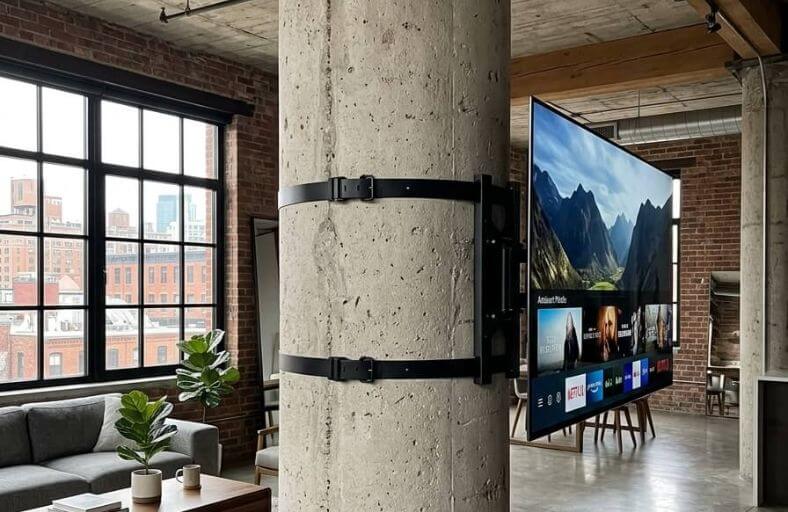
Urban lofts often feature industrial architectural elements like exposed concrete pillars or structural steel columns.
For a renter, these are typically no-go zones for drilling, yet they often represent the most logical place to position a television in an open-concept layout.
The ratchet-strap column mount is a specialized piece of hardware designed to wrap around a pillar and use tension to secure the screen.
The mechanism is simple yet robust. Industrial-grade straps are looped around the column and tightened using a ratchet system, creating a rock-solid foundation for a VESA bracket.
This method leaves zero marks on the concrete or steel and can support televisions up to 70 inches.
It also offers viewing flexibility, as the mount can often be rotated around the pillar to face different areas of the room.
Tension-Pole Support System
A television tension pole uses a heavy-duty spring-loaded or screw-jack mechanism to apply pressure between the floor and the ceiling. This creates a vertical support beam that requires no fasteners at all.
It is an ideal solution for studio apartments where you might want to use the television as a room divider.
| Solution | Best For | Max Weight (Approx) |
| Pedestal Stand | Flexibility & Mobility | 80-150 lbs |
| 45-Degree Nails | Floating Aesthetic | Up to 150 lbs |
| Column Mount | Industrial Lofts | Up to 110 lbs |
| Tension Pole | Room Partitioning | Up to 55 lbs |
Most tension-pole mounts allow for full-motion adjustment, meaning you can tilt and swivel the screen with ease.
However, users should be cautious with high-texture popcorn ceilings, as the pressure can sometimes cause the texture to flake or crack.
Hybrid Media Console
The hybrid media console is a specialized piece of furniture that features a built-in mounting bracket attached to its frame.
This setup offers the visual benefit of a wall-mounted TV, where the screen appears elevated with clear space underneath, but the furniture itself supports the weight. It is an excellent choice for those who want a mounted aesthetic without any wall contact.
These consoles are highly practical for renters because they integrate storage and organization into one cohesive unit.
They typically offer closed cabinets or open shelving for gaming consoles, soundbars, and streaming devices, effectively hiding visual clutter while keeping electronics accessible.
Because the bracket is built-in, you avoid the risks of misaligned drilling or finding studs. When choosing a hybrid console, ensure the base is wide and heavy enough to prevent tipping, particularly for larger screens.
Professional Rolling TV Carts
Modern rolling TV carts have evolved from classroom equipment into sleek, professional-grade floor stands that offer ultimate flexibility.
These mobile mounts allow you to move your television between rooms effortlessly, making one screen viable for both a living area and a bedroom.
They are constructed with high-quality steel and feature locking casters that ensure stability once the cart is in position.
Rolling carts are particularly beneficial in small apartments or flex spaces where the room layout might change frequently.
Many models include height-adjustable poles and integrated shelves for AV equipment, allowing for ergonomic viewing at various levels.
Because they are entirely freestanding and take up less room than traditional consoles, they fit well into tight corners or beside exercise equipment.
They represent a zero-hole, zero-hassle solution that travels with you to your next home.
Furniture-Top VESA Pedestals
If your television came with wide, unstable legs that do not fit on your favorite vintage sideboard, a furniture-top VESA pedestal is the perfect upgrade.
These replacement bases bolt directly into the VESA mounting holes on the back of your TV, providing a sturdy, centralized neck.
Most high-quality pedestals use a heavy tempered-glass or steel base to provide superior stability compared to factory-issued feet.
The primary advantage of this solution is its space-saving footprint and adjustability. Many models offer a swivel function, allowing you to turn the screen up to 30 degrees to reach different seating areas or reduce window glare.
They also allow for height adjustment, which is critical for clearing a soundbar placed directly beneath the screen.
This is an affordable, drill-free way to improve both the safety and the aesthetic of your media setup on existing furniture.
Over-the-Door Mounting Systems
For the ultra-space-challenged renter, an over-the-door mounting system provides a creative way to reclaim wall and floor space.
This system uses a padded steel bracket that hooks over the top of a standard interior door, distributing the weight across the door’s frame.
It is a perfect solution for bedrooms or home offices where wall space is occupied by windows or radiators.
While these mounts are generally limited to smaller screens, typically up to 43 inches, they require absolutely no tools or drilling.
They offer a modern, suspended look that stays entirely clear of the floor and walls.
| Feature | Rolling TV Cart | Hybrid Console | VESA Pedestal |
| Mobilty | Excellent (Wheels) | Stationary | Stationary |
| Storage | Minimal Shelving | High (Cabinets) | Minimal |
| Installation | Simple Assembly | Moderate Assembly | Very Simple |
| Wall Damage | Zero | Zero | Zero |
When using this solution, it is important to ensure the door is solid-core for maximum stability and to manage cable slack properly to prevent wires from snagging when the door is opened.
Gallery-Style Picture Rail Hangers
Many older, heritage apartments feature a picture rail, which is a horizontal molding that runs around the room near the ceiling.
Historically used to hang heavy paintings without damaging plaster, these rails can be repurposed for a truly unique TV mounting solution.
By using high-strength steel cables and adjustable hooks, you can suspend a television from the rail, making the screen essentially “hang” like a piece of art.
This look is incredibly sophisticated and fits perfectly with the “dark academia” or traditional interior design trends.
To prevent the TV from swinging or leaning forward, most residents use a small piece of foam or a non-slip pad behind the screen to keep it stable against the wall.
This method is almost entirely invisible, as the thin cables blend into the wall, creating a magical floating effect that is entirely damage-free.
Prop-Up Easel Stand
If you want your television to look less like an appliance and more like a work of art, the easel stand is the ultimate lifestyle choice.
Inspired by the wooden easels used by painters, these stands are typically made of high-quality wood such as walnut or oak, or minimalist tripod steel.
The TV sits on the tripod, which can be placed in a corner or even in the middle of a room as a statement piece.
Easel stands are a favorite among fans of “The Frame” TV by Samsung, as it reinforces the illusion that the screen is a piece of fine art.
They are entirely freestanding, requiring no wall attachment, and their three-legged design is surprisingly stable.
Most high-end models even include cable-hiding legs where the power cord runs down the inside of one of the wooden supports, maintaining a clutter-free aesthetic.
Modular Backboard Panels (False Walls)
When you want the look of a full media wall but the landlord says no to drilling, you can build a “false wall” or a modular backboard panel.
These are large, decorative panels made of wood or lightweight MDF that are secured between the floor and ceiling using hidden tension feet or by leaning them against the wall at a slight angle.
Since you are drilling into your own piece of wood rather than the apartment’s drywall, you have complete freedom to cut holes for cable management or add LED backlighting.
These panels can be covered in trendy fluted wood slats or painted a bold accent color to create a high-end focal point that you can take with you when you move.
This is a more involved DIY project, but it offers the most custom look possible in a rental environment.
Sliding Track Mounts for Closets
In very small studio apartments, the only available wall space might be inside a closet or a wardrobe.
A sliding track mount allows you to mount the TV inside the closet and slide it out when you want to watch.
The track is usually bolted to a heavy piece of plywood that is secured to the closet shelving or the floor, avoiding any direct contact with the apartment’s main walls.
This is a creative way to maximize functionality in a space where every square foot counts.
It allows you to hide your entertainment center during the day, maintaining a clean, minimalist space, and then pull it out for movie night.
| Solution | Style Profile | Space Efficiency | Installation Effort |
| Picture Rail | Traditional / Heritage | High | Low |
| Easel Stand | Artistic / Minimalist | Medium | Very Low |
| Modular Panel | Architectural / High-End | High | High (DIY) |
| Sliding Track | Utility / Hidden | Very High | High (DIY) |
While this setup requires some planning for cable slack, it is a brilliant engineering “hack” for modern urban living.
Command Strip Wall Clamps (For Small TVs)
For ultra-lightweight setups, particularly in kitchens or small home offices, some renters utilize industrial-strength adhesive mounting systems.
These systems use specialized wall clamps or Velcro-based strips that adhere directly to the wall surface without any hardware. This solution is ideal for televisions under 32 inches and weighing less than 10 to 15 pounds.
The primary risk with adhesives is the potential for peeling paint or tearing drywall paper during removal, which can sometimes cause more visible damage than a small nail hole.
To minimize this, it is critical to follow the manufacturer’s curing time and weight ratings exactly.
For many, this remains a quick, tool-free option for temporary or flexible apartment arrangements where permanent modifications are strictly forbidden.
Magnetic Stud-Mounting
Modern high-rise apartments often use metal studs rather than traditional wood framing, creating a unique opportunity for magnetic mounting technology.
Specialized mounting plates can be secured to the wall using high-strength neodymium magnets that clamp onto the metal studs behind the drywall.
This method requires zero drilling and allows the mount to be repositioned easily along the stud’s path.
Because drywall alone cannot support the weight of most televisions, magnetic stud-mounting provides the structural integrity needed for a safe installation without breaking the wall surface.
However, it is vital to use a high-quality magnetic stud finder to verify the exact location and material of the stud before trusting it with an expensive screen. This niche solution represents the cutting edge of damage-free urban integration.
Ceiling-Suspended Joist Mounts
When wall space is occupied by windows or architectural details, the ceiling can offer a robust alternative.
Ceiling mounts drop a pole down from the top of the room, creating a suspended look that is particularly popular in lofts or bedrooms.
In many industrial-style rentals, residents can use beam clamps to attach these mounts to exposed joists without any drilling at all.
This method completely frees up floor space and allows for 360-degree viewing flexibility in open layouts.
However, if the ceiling is finished drywall, it is mandatory to anchor directly into a structural joist rather than just the ceiling board to prevent the mount from tearing out.
For the design-conscious renter, the suspended TV offers a modern, high-end aesthetic that keeps the walls clear for art and mirrors.